The Tired Mom’s Trick for Cheaper Dinners
Aug 22, 2026Let the internet make your dinner list cheaper, calmer, and way more flexible
Dinner does not need to be a full-time job.
It also does not need a color-coded spreadsheet, a laminated meal plan, or one more person on the internet telling you to “just prep on Sundays.”
No, thank you. Sunday Stacey is tired too.
Here’s what we do need:
- A short grocery list.
- A few flexible meals.
- Store brands when they make sense.
- The ability to let the internet do some of the annoying math.
So I ran a tiny dinner experiment.
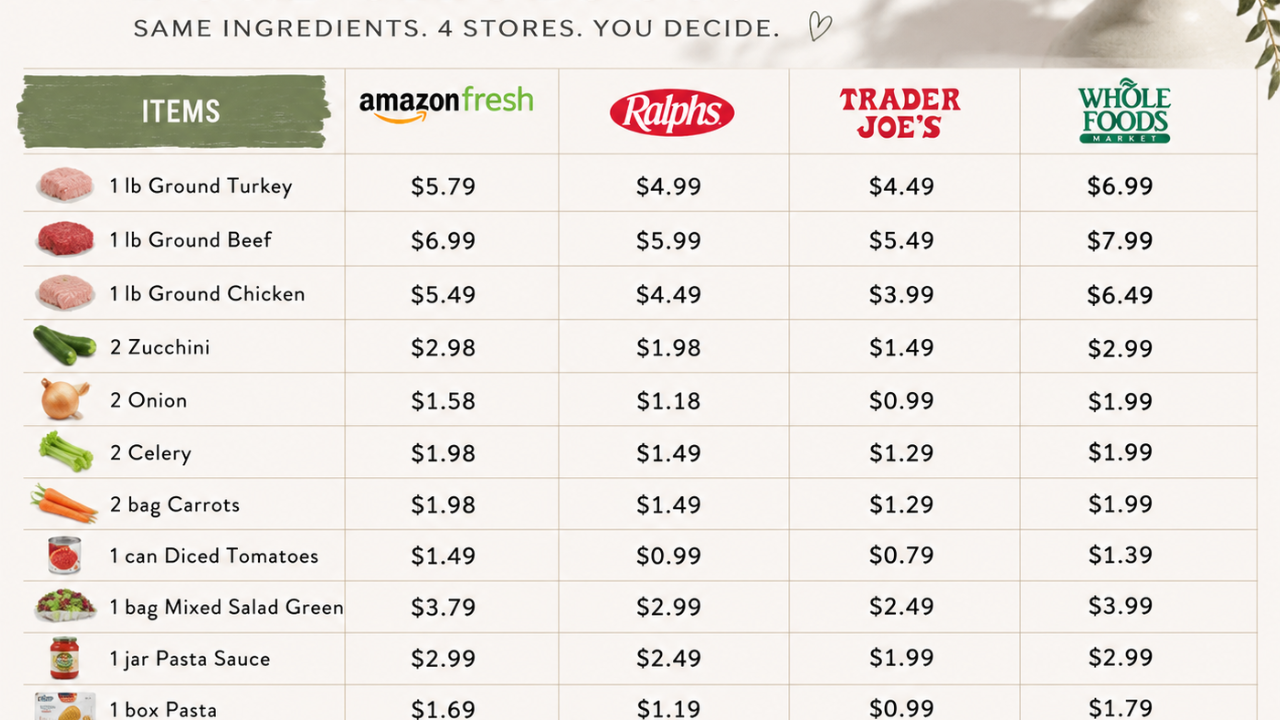
I took one simple 11-ingredient list, checked it across Ralphs/Kroger, Trader Joe’s, Amazon Grocery, and Whole Foods/365, and asked the obvious tired-mom question:
Where can we get the most dinner flexibility for the least amount of money?
Not perfect.
Not precious.
Not “I made my own broth while the children quietly read novels.”
Just real food, real carts, real life.
The grocery list
The list was intentionally basic.
Because basic is not bad.
Basic is where dinner lives.
Here’s the 11-ingredient list:
- 1 lb ground turkey
- 1 lb chicken
- 1 lb ground beef
- 1 head celery
- 2 onions
- 2 zucchini
- 1 bag carrots
- 1 can diced tomatoes
- 1 bag mixed salad greens
- 1 jar pasta sauce
- 1 box generic pasta
That’s it.
No specialty sauces.
No tiny jar of something that costs $9 and gets used once.
No ingredient that requires you to whisper, “Do we even eat fennel?” in the produce aisle.
I chose store brands whenever possible because store brands are often the quiet little heroes of the grocery cart.
Not glamorous.
Very useful.
We love useful.
The real win
This is where ChatGPT, online grocery browsing, or any similar tool gets very handy.
Not because we need robots to raise our children.
Absolutely not. The robots can start by folding the laundry and then we’ll talk.
But for grocery comparison?
Yes.
Hand it over.
You can use the internet to:
- Compare carts before you leave the house
- Spot when store brands save real money
- Swap ingredients without wrecking dinner
- Build one list that turns into several meals
- Stop standing in aisle 6 doing dinner math with a child asking for fruit snacks
That last one is a public service.
How to use ChatGPT for this
Here’s the simple version.
Open the grocery sites you already use.
Search the ingredients.
Choose store brands when possible.
Then paste the prices into ChatGPT and let it organize the mess.
Use a prompt like this:
“Help me compare this grocery list across stores. Prioritize store brands when possible. Tell me which store is cheapest overall, where the biggest price differences are, and what swaps would keep the dinners flexible. Here is the list: 1 lb ground turkey, 1 lb chicken, 1 lb ground beef, 1 head celery, 2 onions, 2 zucchini, 1 bag carrots, 1 can diced tomatoes, 1 bag mixed salad greens, 1 jar pasta sauce, 1 box generic pasta.”
Then add the prices you find.
If you are using a browsing-enabled tool, you can ask it to help search current prices.
If you are not, just copy and paste the prices from the carts yourself.
Either way, the job is the same:
- Make the list easier to understand.
- Make the swaps obvious.
- Make dinner less dramatic.
Save the drama for the toddler who wanted the banana peeled but also not peeled.
What to ask it
Once you have prices, ask better questions.
Not fancy questions.
Useful ones.
Try these:
“Which items are driving the total up?”
“Where should I use store brand?”
“What can I swap if chicken is expensive this week?”
“Can this list make 4 to 5 dinners with pantry staples?”
“What should I buy more of if I want leftovers?”
“Turn this into a flexible dinner list, not a rigid meal plan.”
That last one matters.
Rigid meal plans break the second someone eats the lunch chicken at 3:42 p.m.
Flexible dinner lists survive real life.
Why flexibility matters
The goal is not to win grocery shopping like it’s an Olympic event.
The goal is to have enough ingredients in the house to make dinner without starting from zero every night.
This 11-ingredient list works because it gives you options.
You have three proteins:
- Ground turkey.
- Chicken.
- Ground beef.
You have vegetables that can go into almost anything:
- Celery.
- Onions.
- Zucchini.
- Carrots.
- Salad greens.
You have easy sauce and base ingredients:
- Diced tomatoes.
- Pasta sauce.
- Generic pasta.
Now add pantry staples.
Olive oil. Salt. Pepper. Garlic powder. Italian seasoning. Rice if you have it. Broth if you have it. A little cheese if the fridge is feeling generous.
Suddenly this tiny list is not tiny.
It’s dinner infrastructure.
A very unsexy phrase.
A very beautiful reality.
What this list can become
Inside Kitchen Sessions, we have over a dozen recipes that use these ingredients plus pantry staples.
Because this is the whole point:
You do not need a brand-new grocery list for every single recipe.
You need one smart list that bends.
With these ingredients, you can make things like:
- Turkey tomato pasta
- Beef and zucchini marinara skillet
- Chicken vegetable soup
- Ground beef pasta bowls
- Turkey meat sauce
- Chicken salad bowls
- Zucchini and beef skillet
- Chicken pasta with greens
- Veggie-loaded tomato soup
- Turkey and carrot skillet
- Simple meat sauce with pasta
- Chicken and veggie bowls
- Ground turkey stuffed-ish zucchini
- Clean-out-the-fridge pasta night
Nothing precious.
Nothing complicated.
No dinner that requires a pep talk and three pans you do not want to wash.
Just meals that use what you bought.
The store brand rule
Start with store brand.
That is the rule.
Store-brand pasta.
Store-brand diced tomatoes.
Store-brand sauce.
Store-brand salad greens if they look good.
Store-brand meat when the price and quality make sense.
Then check the price difference.
Sometimes the name brand is on sale.
Sometimes the store brand is the clear winner.
Sometimes one store is randomly charging too much for zucchini like it personally grew it in a silk robe.
This is why comparing helps.
You are not trying to become a coupon wizard.
You are trying to stop overpaying because you were rushed.
Delivered can still be worth it
One of the most interesting parts of this little test was Amazon Grocery.
It came in around $31 to $35 and was delivered.
Delivered.
As in, the groceries come to you and you do not have to take anyone through the cereal aisle.
That does not mean it will always be cheapest.
It does mean delivery should not automatically be dismissed as “too expensive.”
Sometimes the cheapest option is the one that saves money.
Sometimes the best option is the one that saves your 5 p.m. sanity.
Sometimes, miracle of miracles, it can do both.
We receive that.
The bigger lesson
A cheaper dinner list is great.
A flexible dinner list is better.
Because when dinner is flexible, you are not trapped.
Chicken too expensive?
Use ground turkey.
No zucchini?
Use carrots and celery.
Pasta sauce on sale?
Grab two.
No energy for a recipe?
Brown meat, add sauce, boil pasta, throw greens on the side, call it dinner.
That counts.
Please hear me.
That counts.
Want the recipes that make this easier?
If you want the recipes that make this kind of list actually work, come take the free Kitchen Sessions class.
You’ll learn how to turn simple ingredients into real dinners without overthinking, overspending, or starting from scratch every night.
Less panic.
More options.
Dinner that bends with your life.
Watch the free Kitchen Sessions class
Stay connected with news and updates!
Join our mailing list to receive the latest news and updates from our team.
Don't worry, your information will not be shared.
We hate SPAM. We will never sell your information, for any reason.