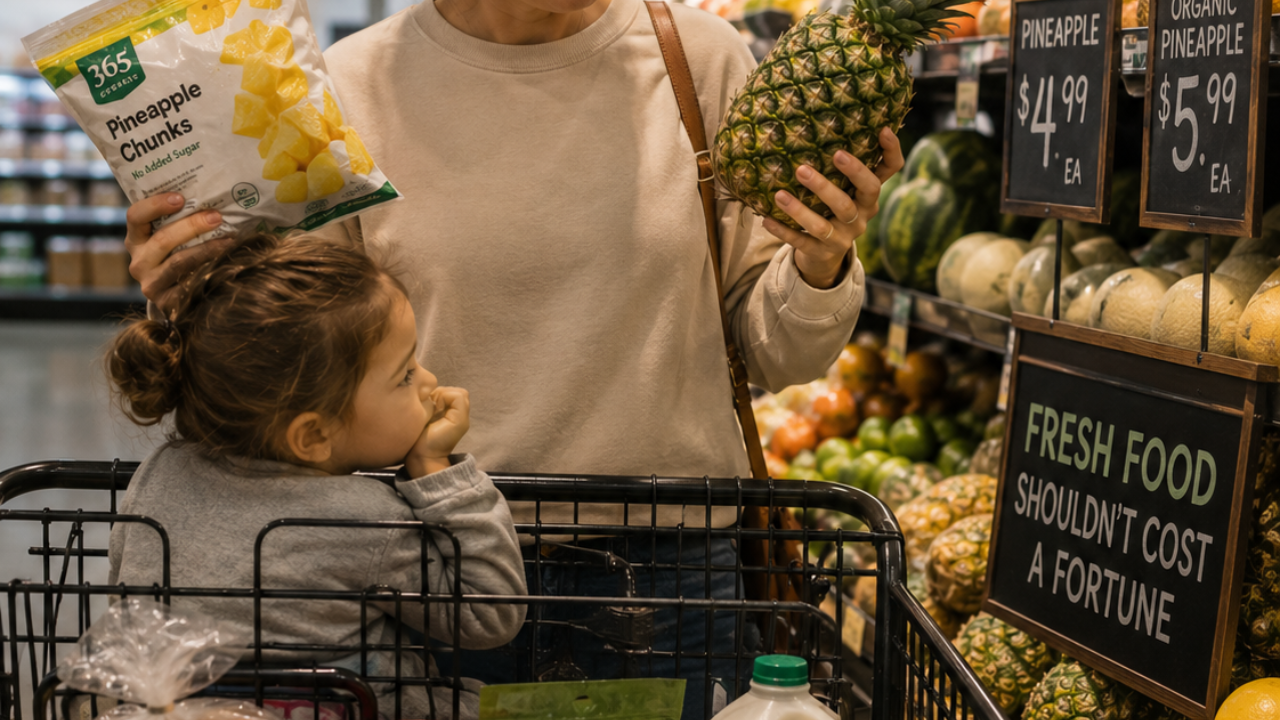
How Busy Moms Save Money at the Grocery Store Without Sacrificing Healthy Meals
Aug 07, 2026How Busy Moms Save Money at the Grocery Store Without Sacrificing Healthy Meals
Feed your family well without letting the grocery bill run the house.
Grocery shopping as a mom can feel like a full-contact sport.
You are checking prices, dodging snack requests, thinking about what is already in the fridge, trying to remember who suddenly hates bananas, and somehow still aiming to feed your family meals that actually support their bodies.
And the bill? Whew.
Healthy food can feel expensive, but feeding your family well does not mean you need a luxury budget. You do not have to buy every organic item, make everything from scratch, or spend your whole Sunday prepping perfect little containers.
You just need to shop with a plan, use what you buy, and make the most of the foods your family already loves.
This is not about being fancy. This is about being a smart shopper.
Because every penny counts.
And so does your family’s future health.
Know what your family actually eats most
Before you even walk into the store, start with the real-life truth of your house.
What does your family eat every week?
Not what you wish everyone ate. Not what looked cute on Pinterest. Not what you bought last month and watched slowly wilt in the fridge.
What do they actually eat?
Maybe your kids crush berries, eggs, yogurt, rice, chicken, apples, cucumbers, ground turkey, oatmeal, peanut butter, frozen peas, or sweet potatoes.
Those are your staples.
When you know your family’s most-used foods, you stop guessing. You stop tossing random “healthy” items into the cart because they seem like a good idea. You start building meals around what already works.
That is where the savings begin.
A simple mom move: keep a note in your phone called Family Staples. Add the foods your people eat consistently. Before every grocery trip, check what you already have and restock only what you need.
This one habit can cut down on waste, stress, and those annoying midweek store runs that somehow cost $47 every single time.
Buy seasonal produce and let the calendar help your budget
Seasonal produce is one of the easiest ways to save money while still feeding your family nutrient-dense meals.
When fruits and vegetables are in season, they are usually more affordable, easier to find, and better tasting. That means your kids are more likely to eat them, which is the whole point.
Think strawberries in spring, peaches and zucchini in summer, apples and squash in fall, citrus and sweet potatoes in winter.
Seasonal produce gives you variety without needing to overthink it.
If something is in season and on sale, build around it.
Got a great price on apples? Add them to oatmeal, slice them with peanut butter, pack them in lunches, or bake them with cinnamon.
Found affordable zucchini? Shred it into eggs, add it to pasta sauce, roast it, or mix it into muffins.
Seasonal shopping is not complicated. It is letting what is fresh, available, and priced well lead the way.
That is smart mom energy.
Frozen produce is not a backup plan. It is a power move.
Let’s clear this up right now: frozen fruits and vegetables are absolutely okay.
More than okay.
They are smart.
Frozen produce is often picked at peak ripeness and frozen quickly, which helps lock in nutrients. It lasts longer, costs less in many cases, and saves you from the heartbreak of opening the fridge to find a soggy bag of spinach you had big dreams for.
Frozen berries can go into smoothies, oatmeal, yogurt bowls, and muffins.
Frozen broccoli can be tossed into pasta, rice bowls, eggs, soups, or sheet pan meals.
Frozen peas, carrots, peppers, spinach, mango, cauliflower, and green beans can all help you get color and nutrients on the plate without racing the expiration clock.
If fresh produce keeps going bad in your house, frozen might be the better choice.
That is not lazy.
That is knowing your season of life.
Busy moms need food that works with them, not food that punishes them for having a full schedule.
Store food like you paid for it, because you did
One of the biggest grocery budget leaks is food waste.
You buy the food. You bring it home. Then life happens. The lettuce gets crushed, the berries mold, the herbs turn sad, and the leftovers disappear into the back of the fridge until nobody is brave enough to open the container.
That is money in the trash.
The goal is not to become a professional food storage expert. The goal is to make your food easier to see, use, and enjoy.
Wash and dry berries only when you are ready to eat them, or store them with a paper towel to help absorb moisture.
Keep leafy greens dry and sealed with a paper towel in the container.
Move older food to the front of the fridge so it gets used first.
Store cut vegetables in clear containers so they do not vanish behind the milk.
Freeze ripe bananas for smoothies or baking.
Freeze leftover rice, soup, cooked meat, or chopped vegetables before they go bad.
Label containers with the date if your fridge tends to become a mystery zone.
Small storage habits protect your grocery money.
They also make healthy choices easier because the food is ready, visible, and not quietly dying in the produce drawer.
Plan around nutrition, not perfection
Healthy meals do not need to be complicated to be powerful.
A nutritionally dense meal can be simple: protein, fiber, healthy fat, and color.
Eggs with sautéed spinach and toast.
Chicken, rice, avocado, and frozen broccoli.
Greek yogurt with berries, oats, and nut butter.
Turkey tacos with beans, lettuce, salsa, and peppers.
Lentil soup with carrots and greens.
Tuna over whole grain crackers with cucumbers and fruit.
These meals are not flashy, but they work. They fill bellies, support energy, help kids grow, and keep moms from feeling like short-order cooks every night.
Future health matters.
The food choices you make now help shape your family’s habits, immune strength, energy, digestion, and relationship with food. That does not mean every bite must be perfect. It means the daily pattern matters.
A family that eats beans, eggs, oats, fruit, vegetables, rice, yogurt, soups, nuts, seeds, fish, chicken, whole grains, and simple homemade meals is building something strong.
Even on a budget.
Especially on a budget.
Use your money where it matters most
You do not have to buy the most expensive version of everything.
You are not failing if your cart has store-brand oats, frozen vegetables, canned beans, regular apples, or bulk rice.
You are feeding your family.
That is the mission.
If your budget is tight, focus on foods that give you the most nutrition for the money.
Great budget-friendly options include:
- Eggs
- Oats
- Rice
- Beans
- Lentils
- Potatoes
- Sweet potatoes
- Frozen vegetables
- Frozen fruit
- Canned tuna or salmon
- Peanut butter
- Greek yogurt
- Cottage cheese
- Bananas
- Apples
- Carrots
- Cabbage
- Whole grain pasta
- Ground turkey or beef when on sale
- Chicken thighs
- Seasonal produce
These foods can stretch into breakfasts, lunches, dinners, snacks, and leftovers without draining your account.
Not rich.
Just resourceful.
Not fancy.
Just smart.
Watch the sneaky budget traps
Sometimes the grocery bill is high not because of the healthy food, but because of everything orbiting around it.
Single-serve snacks. Pre-cut fruit. Special drinks. Individually wrapped everything. Random extras at checkout. Foods bought with no plan. Produce bought because it looked pretty but nobody eats it.
Convenience has a place. Busy moms are allowed to choose convenience when it helps the house run smoother.
But if the budget feels tight, look at the repeat offenders.
Can you buy the big tub of yogurt instead of the small cups?
Can you portion snacks at home?
Can you cut the melon yourself this week?
Can water be the main drink at home?
Can one “fun food” replace five impulse treats?
This is not about stripping joy from the cart. It is about making sure your money is going toward food that truly serves your family.
Shop with a flexible list
A grocery list is your best friend, but it should not be so rigid that you miss the deals.
Instead of writing only “blueberries,” write “fruit for snacks.” Then you can choose what is seasonal, affordable, and fresh.
Instead of writing “asparagus,” write “green vegetable.” Then you can grab broccoli, green beans, spinach, cabbage, or whatever is priced well.
Instead of writing “chicken breast,” write “protein for three dinners.” Then you can compare chicken thighs, ground turkey, eggs, beans, or fish.
This kind of list keeps you focused without locking you into expensive choices.
That is how smart shoppers move.
Use the freezer like a savings account
Your freezer can protect your grocery budget in a big way.
When meat goes on sale, freeze it in meal-size portions.
When bread is buy-one-get-one, freeze the extra loaf.
When fruit is getting too ripe, freeze it for smoothies.
When you make soup, freeze a portion for a busy day.
When vegetables are close to turning, chop and freeze them for future soups, eggs, or stir-fries.
The freezer turns “we need takeout” into “we already have something.”
That one shift can save serious money over time.
Make healthy food easy to grab
Kids eat what they can see.
Honestly, adults do too.
If the grapes are washed, the carrots are cut, the yogurt is easy to reach, and the hard-boiled eggs are ready, those foods have a better chance of getting eaten.
If everything is hidden, unwashed, uncut, or buried under three mystery containers, it becomes invisible.
Try creating one easy-grab zone in the fridge.
Add fruit, cut vegetables, cheese sticks, boiled eggs, yogurt, hummus, or leftovers that need to be eaten first.
This helps your family snack better and waste less.
It also reduces the constant “Mom, what can I eat?” soundtrack.
A true gift.
Give yourself credit for doing the work
Feeding a family is not small.
It is emotional, physical, financial, and constant.
You are thinking about health, preferences, prices, schedules, school lunches, dinners, snacks, and the fact that someone will absolutely announce they are starving right after saying they were not hungry.
So no, this does not have to be perfect.
You can serve frozen vegetables.
You can buy store brands.
You can repeat simple meals.
You can choose seasonal produce.
You can stretch meat with beans.
You can freeze leftovers.
You can skip the expensive health trends and still raise a well-fed family.
The goal is not to look like you have unlimited time and money.
The goal is to make strong choices with what you have.
That is powerful.
That is practical.
That is mom wisdom in motion.
The bottom line
You do not need to be rich to feed your family healthy, nutrient-dense meals.
You need to know what your family eats most, shop with intention, buy seasonal when you can, use frozen produce proudly, store food well, and protect every penny from waste.
Healthy eating on a budget is not about restriction.
It is about strategy.
It is choosing food that fuels your family today and supports their health for the future.
One smart grocery trip at a time.
Stay connected with news and updates!
Join our mailing list to receive the latest news and updates from our team.
Don't worry, your information will not be shared.
We hate SPAM. We will never sell your information, for any reason.